Developing Sustainable System for Future Data Centers
Authors
Abdullah ayad ALHARBI - Aramco, Saudi Arabia
Nasser ayidh ALQAHTANI - GCC Lab, Saudi Arabia

Summary
The rapid expansion of the data center industry has led to increasing energy consumption and carbon emissions, necessitating the development of sustainable power solutions. This study examines four different energy models for a hypothetical 5MW data center to be built at a location in GCC. The evaluation of designs was based on technical feasibility and environmental conservation. The goal is to identify an optimized, eco-friendly energy model that enhances efficiency while reducing operational costs and environmental impact. The economic analysis is very dependent on-site location and thus not considered in this evaluation.
The paper explores the limitations of traditional data centers that primarily rely on utility grid power with diesel generators as backup sources. These systems are inefficient, with significant energy losses and high carbon emissions. As an alternative, three hybrid models integrating solid oxide fuel cells (SOFC) and micro gas turbines (MGT) are proposed. The most optimal model consists of a hybrid SOFC-MGT system as the primary energy source, a utility grid as a secondary source, and a proton exchange membrane fuel cell (PEMFC) as an emergency backup. This model improves reliability, reduces power losses, and significantly decreases carbon emissions.
From a technical perspective, the hybrid SOFC-MGT system enhances reliability by integrating multiple power sources, ensuring continuity even during maintenance or unexpected failures. The system achieves an overall energy efficiency of 65%, compared to 34% in traditional models. It also reduces power losses from 66% in conventional data centers to 42%.
In terms of environmental benefits, the proposed model cuts carbon emissions by 66% compared to the conventional system. Additionally, waste heat generated from the system is repurposed within the micro gas turbine, further optimizing energy utilization and minimizing environmental impact.
The findings emphasize the urgent need to transition from traditional data center energy models to more sustainable alternatives. The hybrid SOFC-MGT model with utility and PEMFC backup demonstrates a viable solution for enhancing energy security, and significantly lowering carbon emissions. This paper provides a framework for future data center developments, showcasing the potential of fuel cell technology in driving sustainable innovation in the industry.
Keywords
SOFC, PEMFC, Data Center, Grid, Sustainable, Natural Gas1. Introduction
Nowadays, data centers industry has significant energy-intensive operations, and it accounts for about 3% of global electricity and produces 2% of global GHG emissions [1]. The data centers are undergoing massive growth in the upcoming years, and it is predicted to increase the power consumption by a double for every four years [2]. This is a challenge, especially when the expansion is going exponentially for data-based applications such as video streaming, cloud computing, digitalization, and so on. In the old days, data center managers were putting efforts in the demand-side management to reduce the overall power consumption, specifically by improving energy efficiency and optimization programs. This traditional approach is not sufficient alone to tackle the massive growth of data centers power demand. Instead, it is particularly important to consider the supply-side management by looking to alternative green and sustainable energy sources. These efforts will count for the global decarbonization trajectories to reach net-zero carbon emissions by 2050 as per Paris agreement.
2. Literature review
The data center industry is undergoing massive changes to meet the increasing demand for modern data-driven applications. These changes in the DC industry favor the utilization of waste byproducts such as heat to increase the overall efficiency and improve the circularity and recyclability of byproducts. Climate change can also be considered a business opportunity for waste heat utilization equipment manufacturers [3]. The direct current (DC) infrastructure for data centers offers significant improvement comparing to alternate current (AC) infrastructure. Some key benefits of DC powered data center include less complexity, less space, power quality, modular and scalable, and integration with mixed on-site renewable resources [4]. It was reported by ABB, the Direct Current (DC) data centers outperform the legacy AC data centers by having 10% improvement in energy efficiency, 15% lower investment costs and 25% less space required. However, beside these benefits, there are some limitations include lack of standards, refactoring cost, limited DC power resources and lack of knowledge [5]. There are currently some DC data centers exist in different countries including China, Japan, United States, Germany, and Switzerland [6]. A hybrid system of solid-oxide fuel cell (SOFC) with micro gas turbine (MGT) can boost the overall system to reach more than 70% [7].
3. Problem formulation
A hypothetical 5MW data center is to be built at a location in GCC, where the solar and wind renewable resources are not attractive to be considered due to the limitation of wind blowing and harsh environment, specifically the dust and heat. However, there is a nearby natural gas plant and can supply natural gas (CH4) fuel to the new data center. Also, there is a nearby utility substation which can provide power supply as needed. It is required to overcome these renewable energy resources challenges and to have a low-carbon and sustainable model for this new data center. It is also required to consider a holistic approach to address both the demand and supply sides management to improve the power usage effectiveness (PUE) and to have the lowest CO2 emissions of daily operations. As a rule of thumb, a lower value of PUE means more efficient data center.
The data center energy consumption consists of two major types of loads, namely IT equipment and building facilities. The IT equipment mainly involve computational servers, storage servers and network equipment while the building facilities include cooling systems, lightings, and other miscellaneous loads. The energy consumption distribution of a typical data center is shown in figure 1:
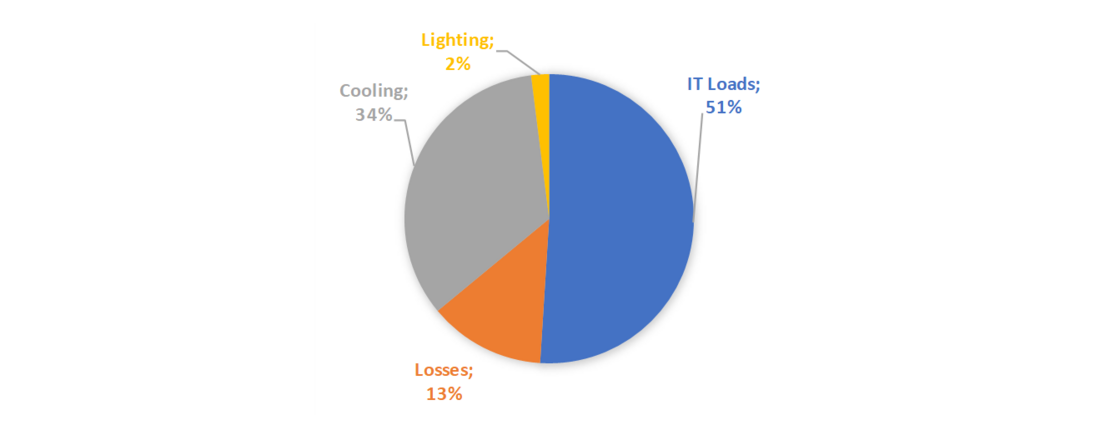
Figure 1 - A generic data center energy consumption [8]
Generally, a data center has a PUE of 2 which means that the power needed to run the IT equipment is half what the entire data center uses, or in other words, the power consumption of IT equipment is equal to the power consumption of other not-IT equipment as shown in figure 1. In figure 2, the estimated load profile of the new proposed data center is shown. It shows the total power consumption of the data center and the IT equipment consumption so whenever the gap between these two lines gets reduced, the value of PUE reduces and the efficiency of data center improves.
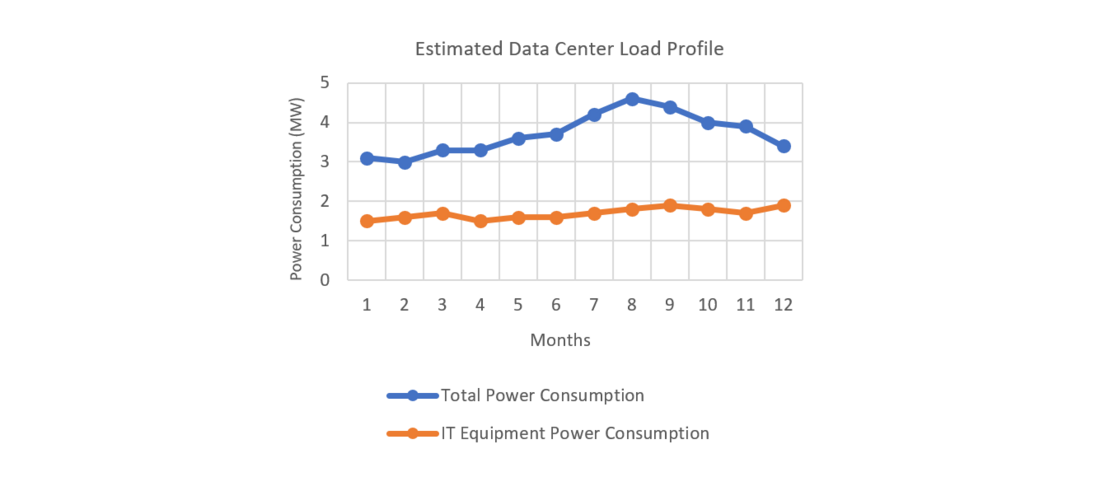
Figure 2 - Estimated load profile of the new data center
4. Methodology
Sometimes it is challenging to consider the solar and wind resources to be utilized in generating power for a new project. A key approach is to get benefit from the geographic location resources. In this project, the natural gas can be supplied to the new data center due to the fact of proximity to a natural gas plant. Based on this energy resource, this paper will assess four different design models. In the below subsections, it will be shown the design bases and assumptions to have a reference for the upcoming cases analysis.

4.1. Design Bases and assumptions
Based on market analysis and benchmarking with existing data centers, the project assumptions and bases were brought up and shown in Table 1. The targeted power capacity is 4 MW for solid oxide fuel cell (SOFC) and 1 MW for the coupled micro gas turbine (MGT) so the overall power output is with efficiency 65%. The capacity factor of SOFC-MGT is 0.9 which is equivalent to 7884 annual operational hours. The fuel used is natural gas (CH4). The capital expenditure cost (CAPEX) is estimated to be 2064 $/kW including the engineering, materials, and construction. Similarly, the parameters for proton exchange membrane fuel cell (PEMFC) and diesel generators are listed in Table 1. The proton exchange membrane fuel cell (PEMFC) is similar to the SOFC in terms of fuel usage and CO2 emissions, but it differs with regards to other aspects such as initial capital cost and response time of startup. The required area for standard 5 MW data center is estimated to be 60,000 m2 based on benchmarking with similar existing data centers. An additional area is required to have on-site generation by SOFC-MGT and estimated to be 1,100 m2. It is worth to highlight that all other components such as IT equipment, cooling units and power converters are common in all models and not counted in the analysis. Instead, only the distinct major elements will be examined.
Item Description | Parameter |
SOFC-MGT |
|
PEMFC |
|
Diesel Generators |
|
CO2 emissions |
|
4.2. Design Models
In the below sub-sections, it will be described the major components of four different models:
4.2.1. Base Case: Utility with Backup Diesel Generator System
This model is the base case and the dominant model for the data centers world-wide. It consists of two types of sources: the utility grid as a primary supply and the diesel generator as a standby supply. The diesel generators work only during power interruption from the grid side. The Uninterruptible Power Supply (UPS) system is used to maintain the power supply to the critical IT equipment during the time of switching between the primary and backup power sources. This model can be shown in figure 3.
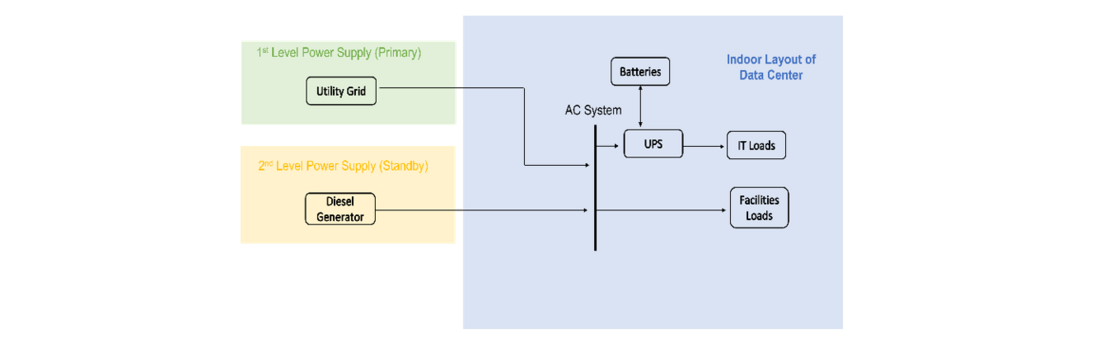
Figure 3 - Model 1 block diagram
4.2.2. SOFC-MGT System with Utility as a Backup
In this model, it is introduced the hybrid system of SOFC-MGT to act as a primary supply and the utility grid as a standby supply to be used in case of failure or scheduled maintenance of SOFC-MGT system. This model eliminates the needs of UPS but still needs power converters namely, rectifier and inverter to condition the power as appropriate for the loads’ requirements. Also, the utility grid takes a place of the diesel generators in a comparison of the base case. This model can be shown in figure 4.
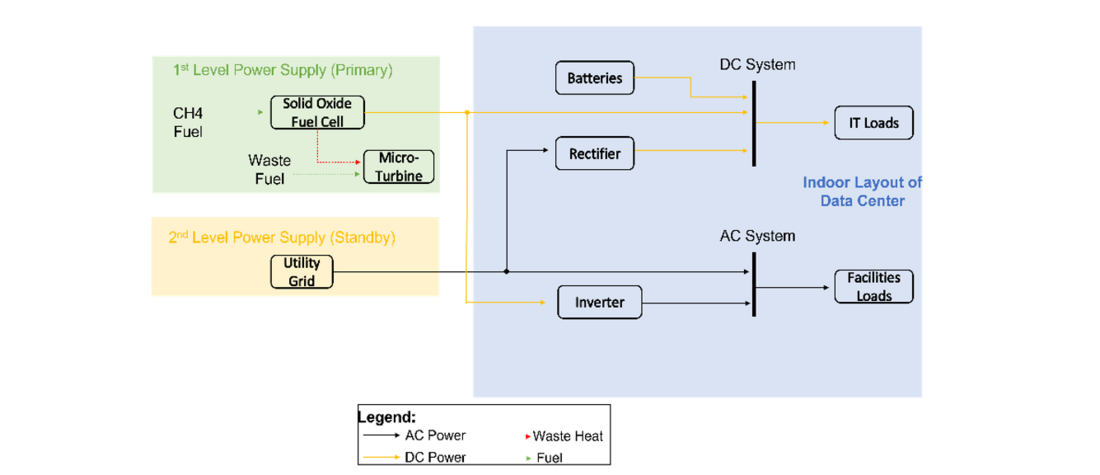
Figure 4 - Model 2 block diagram
4.2.3. Islanded Case: SOFC-MGT System with PEMFC as a Backup
This model represents an islanded system to be totally independent of the utility grid. The SOFC-MGT system acts as a primary supply while the PEMFC act as standby supply. The PEMFC has advantage of being effective to work as a standby because the response time is approximately 20 seconds which is likewise the diesel generator response time so the batteries size will not be affected. Regarding the power converters, this model eliminates the needs of UPS and rectifiers but still needs the inverter to supply the AC system loads. This model can be shown in figure 5.
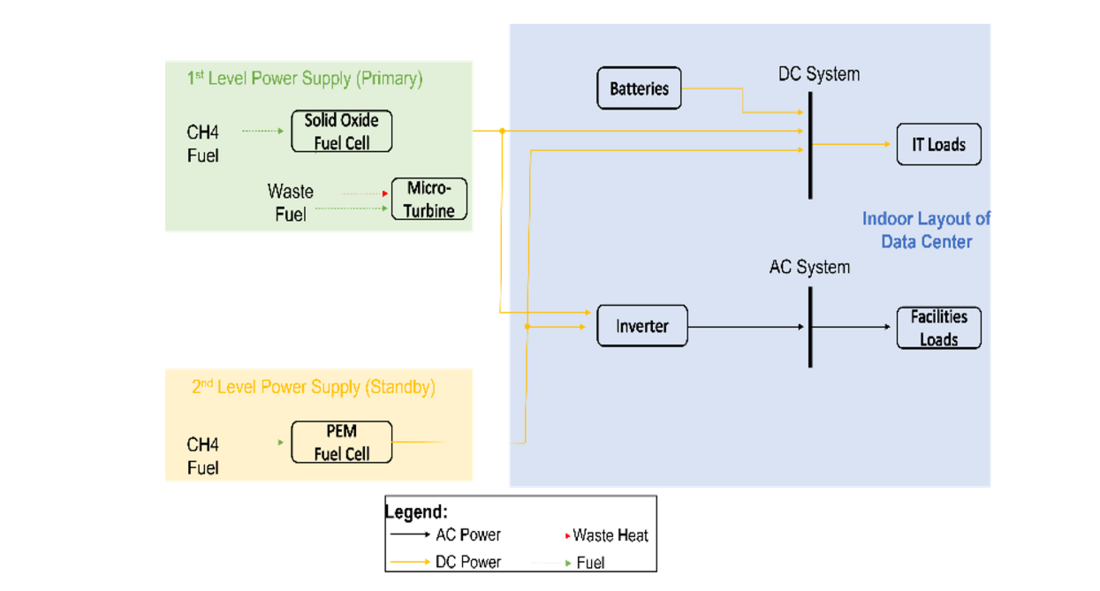
Figure 5 - Model 3 block diagram
4.2.4. SOFC-MGT System with Utility and PEMFC as Backup
In this model, there will be three different levels of power supplies. The SOFC-MGT system acts as a primary supply, the utility grid’s role is a standby during the failure or scheduled maintenance of SOFC-MGT system and the PEMFC acts as an additional backup supply to ensure zero down time of the system. The remaining components are similar to the previous models. This model can be shown in figure 6.
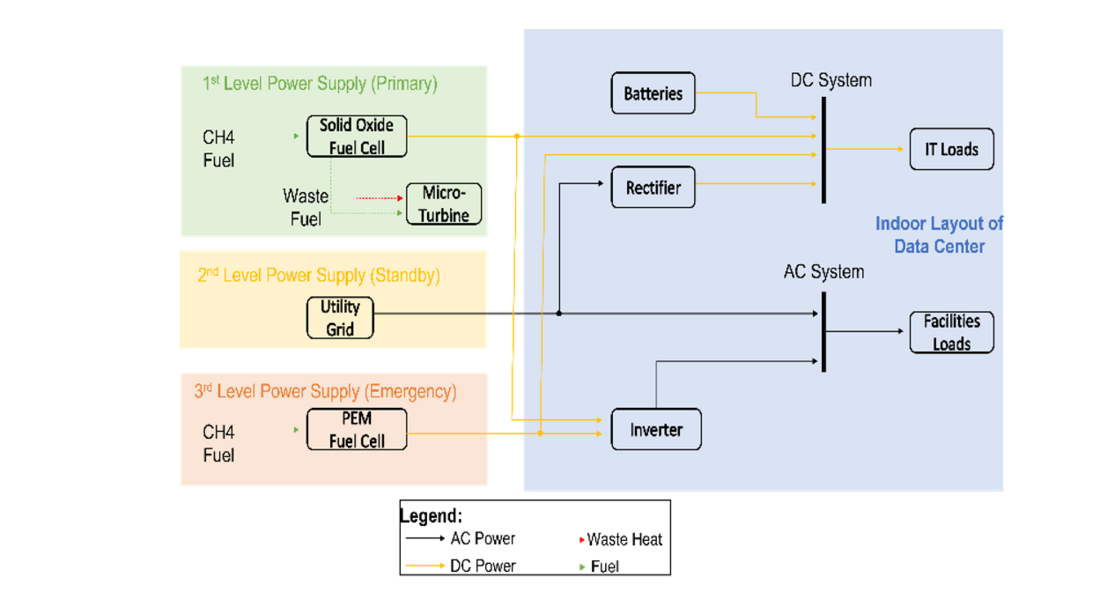
Figure 6 - Model 4 block diagram
5. Analysis and results
This section will assess the abovementioned four models in terms of technical viability and environmental conservation. The first analysis is the technical part to assess the reliability of operations for the examined model, while the second part is the environmental aspects to quantify the CO2 emissions for each model.
5.1. Technical Analysis
Under the technical analysis section, it will be discussed the reliability and how much the power losses would be anticipated of each model:
5.1.1. Reliability analysis
The first model, which is the dominant model for the existing data centers in the globe, is based on the utility grid and backup diesel generators. This model is dependable to the reliability of utility grid so if the grid is reliable then this system is reliable and vice versa. For model 2, the primary source is SOFC-MGT system, and the backup source is the utility grid. The operations of SOFC-MGT system require frequent scheduled maintenance which is estimated to be 876 hours per year and during the maintenance periods the utility grid will supply the load. This model is less reliable due to the possibility of having power failures in the grid during the maintenance schedule of SOFC-MGT system. For model 3, the system is independent of the utility grid and depends on on-site generation to supply the data center. The primary source is SOFC-MGT system while the backup source is PEMFC, and both solely depend on the natural gas fuel. Similarly to the previous case, SOFC-MGT has about 876 hours for maintenance and thus the PEMFC will take place so in case any failure of PEMFC then the overall system is prone to failure. In addition, in case of shortage in the supply of natural gas fuel then the overall system will collapse. As a result, this model is clearly less reliable. Finally, for model 4, it consists of three different levels of power sources, that is the SOFC-MGT system is primary, the utility grid is secondary during SOFC-MGT failure or scheduled maintenance, and the PEMFC is an emergency source in case of failure of both sources. In addition, in case of shortage in natural gas supply, the utility grid can still provide the power beside the stored amount of natural gas for PEMFC. Therefore, this model is the most reliable system among all other models.
5.1.2. Power losses analysis
It is essential to analyze the power losses to realize the efficiency of the models. It will be considered the fuel-to-server efficiency; that is from the generation until the consumption of IT loads. Basically, there are two distinct cases which are the base case (model 1) and the modern case (model 2,3 and 4). For the base case, it is assumed the best-conditioned scenario when the generation plant is based on combined cycle gas turbine (CCGT) with efficiency as high as 55%, and the transmission and distribution networks have average losses of 12% so the total losses in the supply-side is 57%. For the demand side, it is only considered the major components which are the uninterruptable power supply (UPS) with 5% average losses, power distribution units those have built-in step-down transformers (PDUs) with 2% average losses, and power supply units (PSU), those are functioning to condition the power as needed to the IT equipment, with 2% average losses so the total losses in the demand-side is 9%. Therefore, the overall losses of the base case are 66% which is very significant as shown in figure 7.
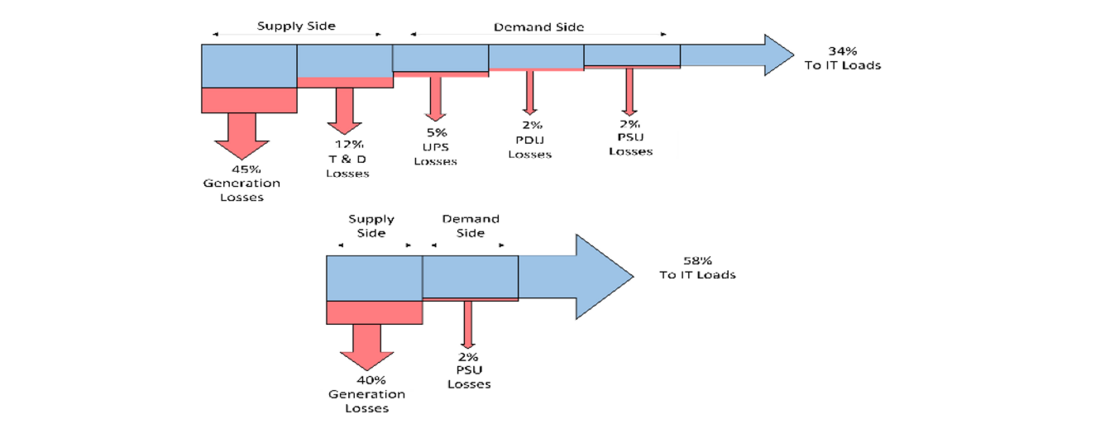
Figure 7 - Base case (up) and modern case (down) power losses diagram
For the modern case, the SOFC-MGT system is built on-site with an overall efficiency of 65% which is a conservative assumption because it was reported that the efficiency of this SOFC-MGT system could reach up to 73% [6]. In the demand side, the output of SOFC-MGT system will be directly connected to the DC distribution panel then to the power supply units (PSUs) those have average losses of 2%, then finally to the IT equipment. Therefore, the overall losses of the modern case are 42% which is exceptional comparing to the base case. Finally, table 2 summarizes the technical results of each model.
| Reliability | Power Losses | |
| Model 1 | Moderate | High |
| Model 2 | Low | Low |
| Model 3 | Low | Low |
| Model 4 | High | Low |
5.2. Environmental Analysis
The environmental conservation is a key consideration in any future projects or investments. One of the main objectives of this project is to decarbonize Scope 2 emissions of the data center operations and to consider environmentally friendly approaches in the design. Also, it is also considered the circular economy design to use the waste byproducts in any other application. In our case, the waste heat from SOFC is recovered in MGT to produce additional power, and hence it maximizes the benefits of the overall byproducts in the system. Depending on the bases and assumptions of table 1, it is calculated the CO2 emissions for each model and the results summarized in figure 8. It is clearly observed that model 1, the base case, is producing significant amount of CO2 emissions which is 23,004 tCO2e while the lowest polluter is model 3 with amount of 6, 514 tCO2e. There are minor variances for the three models 2, 3 and 4.
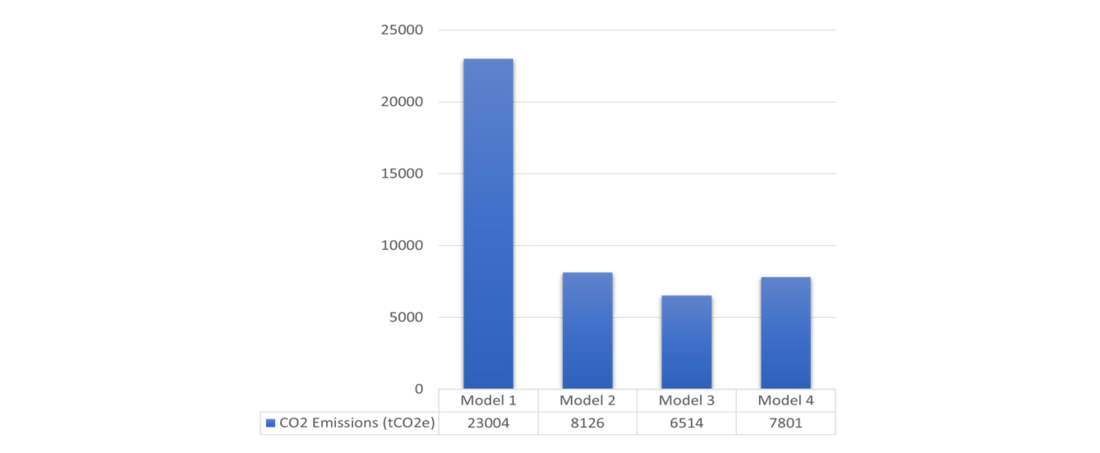
Figure 8 - CO2 emissions of the models
Conclusion
This paper examined four different models in terms of technical and environmental analysis. The results show that model 4 outperforms other models since it significantly improves the reliability of the system, decreases the overall power losses, and decarbonizes the daily operations by 66% in comparison to the base case. Besides that, model 4 offers the possibility to sell electricity to the grid, using the utility for peak shaving and thus reducing capitalizing in oversizing generators, and interchange between sources to increase the lifetime of the generators. Finally, this paper indicates the necessity of changing the traditional data center designs, due to the inefficiency and pollutions, and emphasizes the transformation of energy to greener and sustainable resources.
References
- Zac Aghion, “Towards a Radically More Sustainable Solution for the World’s Data”, The Data Cloud, Snowflake. Accessed on Nov, 2022 [online]
- Why Energy Is a Big And Rapidly Growing Problem For Data Centers. Accessed on Nov, 2022 [online]
- Gaudard, L. (2015). Pumped-storage project: A short to long term investment analysis including climate change. Renewable and Sustainable Energy Reviews, 49, 91–99 [online]
- Howard (2022), Direct Current (DC) Power: Is It the New Normal for Data Centers? | FS Community. Accessed on December 2022 [online]
- A. Schaerer, “DC for efficiency”, ABB review (2013). Accessed on Nov, 2022 [online]
- J. Bachmann, “DC Data Centers: A Necessary Paradigm Shift for Sustainability and Savings”, Connector Supplier (2019). Accessed on Nov, 2022 [online]
- Mitsubishi Power | Fuel Cells. Accessed on Nov, 2022 [online]
- D. Bouley, “Estimating a Data Center’s Electrical Carbon Footprint”, Schneider Electric. Accessed on Nov, 2022 [online]
Biographies
Abdullah A. Al-Harbi possesses more than a decade of applied experience in the engineering of critical backup power architectures for data centers and telecom infrastructures and serving as a Senior Electrical Engineer at Saudi Aramco. His academic credentials include a Master's degree in Sustainable and Renewable Energy and a Bachelor's degree in Electrical Engineering, both conferred by the King Fahd University of Petroleum and Minerals. Eng. Alharbi's current endeavors center on spearheading innovative, sustainable projects that drive the advancement of energy storage technologies and fuel cell systems within the Kingdom of Saudi Arabia.
Nasser A. Al-Qahtani is the Chief Operational Officer at the GCC Testing Laboratory in Saudi Arabia. With over 20 years of experience, he specializes in power system infrastructure and green operationalizing. He holds a Master’s degree in Renewable and Sustainable Energy from KFUPM with First Class Honors. Previously, he served as the Division Manager for Substation Specifications at National Grid SA. Mr. Al-Qahtani directed a $ 2 billion project energy substations and energy labs involving 60 specialized labs, including HV and grid-connection facilities. A PMP-certified leader, his expertise focuses on substation construction, technical specifications, and the commercialization of cutting-edge energy technologies.