Life Cycle Assessment of Power Transformers at the End-of-Life Stage
Authors
Jan DECLERCQ - Slimenergy, Belgium
Geraldine WAHIS, Lara MERTENS - Elia Transmission Belgium, Belgium
Joris DEN BREEJEN - TenneT TSO, Netherlands
Reiko TAKAHASHI - Toshiba, Japan
Milica ĐUKIĆ - NTI, Serbia
Pedro DEL AMO ALONSO - Shell, Spain
Christophe PERRIER - GE Verona, France
Thomas SCHNEIDER - ASTA, Austria
Diana GONZALEZ - Hitachi Energy, Germany
Willem WITJES - Interbaro Recycling B.V., Netherlands
HANG XU - IST Power, UK
Myles MARGOT - Siemens Energy, Germany

The CIGRE Joint Working Group A2/C3.70 addresses the Life Cycle Assessment (LCA) of transformers, covering their environmental impacts across the entire lifecycle, including material production, manufacturing, transportation, operation, and End-of-Life (EoL) stages. This paper reports the outcomes of collective work carried out by the EoL working stream and focuses exclusively on the EoL stage. It summarises recent methodological and industrial developments for assessing the sustainability of transformer decommissioning, dismantling and recycling. By combining detailed descriptions of EoL management processes with an illustrative LCA example, the paper demonstrates how different EoL strategies can influence environmental impacts. The findings provide practical guidance for transformer EoL management, ranging from standard decommissioning practices to lifetime circularity strategies.
Keywords
End-of-Life, Life Cycle Assessment, Power Transformers, Recycling, Sustainability1. Introduction
Power transformers are critical assets in power systems. Across the entire lifecycle, operational losses are the dominant contributor to environmental impacts. However, recent studies indicate that improved practices at the End-of-Life (EoL) stage of transformers, such as circular use and recycling, can deliver substantial environmental benefits [1-5]. Transformers contain various categories of materials, including copper, aluminium, steel, insulating liquids, cellulose insulation, polymers and composites. Most metals and insulating liquids can be recycled at high rates, whereas insulation materials are typically incinerated for energy recovery or disposed of, depending on local infrastructure and regulatory constraints. Therefore, the environmental performance at the EoL stage depends on dismantling practices, material separation efficiency and recycling techniques.
An increasing number of studies have evaluated the carbon footprint (CFP) of transformers at the EoL stage using life cycle assessment (LCA). These studies estimate carbon emissions by comparing scenarios such as disposal, landfilling, and recycling. They also quantify the impacts associated with changes in material quality before and after recycling [1], energy consumption during EoL processes [2, 3], transportation and the resulting reduction in the use of primary resources [4]. In addition, some studies extend the environmental impact assessment of recycling beyond CFP to broader categories [5].
This paper incorporates industrial recycling practices for power transformers at the EoL stage, covering the complete process from decommissioning to final treatment. Past practices, future expectations and key challenges associated with transformer EoL management are discussed. A general EoL-focused LCA methodology is presented, followed by illustrative LCA results to demonstrate its application. The findings provide insights that can support asset owners, manufacturers, and policymakers in facilitating the transition towards circular energy infrastructure, with consideration of transformer sustainability from a lifecycle perspective.
In this paper, the EoL stage is defined as the phase in which a transformer has reached the end of its service life and is removed from operation, encompassing decommissioning, transportation, dismantling, material separation, and recycling or final disposal. Lifetime extension measures, such as refurbishment and spare part reuse, are considered part of the operation stage rather than the EoL stage. While this paper focuses on power transformers, the EoL processes and recycling approaches described are also applicable to other transformer-type equipment with similar construction principles. However, the quantitative recycling data and LCA results in this paper are equipment-specific and are provided for illustrative purposes.
2. Transformer Recycling Process and Future Perspectives
2.1. Overview of Transformer Recycling Process
Transformer EoL management typically involves collaboration between the asset owner and specialised recycling contractors. For the purpose of this paper, the transmission system operator (TSO) is used to represent the asset owner, and the term “TSO” is used hereafter for consistency. Once a transformer is decommissioned by the TSO, it enters a structured recycling process designed to maximise material recovery and minimise environmental impacts. A typical process is summarised in Fig. 1.
Site Assessment and Hazard Identification
Following transformer decommissioning by the TSO, the transformer is handed over to the recycling partner. A site visit is then conducted to document transformer dimensions, access constraints and interfaces with other ongoing works. Potential hazardous materials such as polychlorinated biphenyls (PCBs), hexavalent chromium (Chromium VI), and asbestos are identified through specialised surveys. Transformers manufactured before 1994 often contain potential hazardous materials, and therefore require additional expert analysis and advisory reports.
Oil Draining and Potential Circular Reuse
Insulating liquid, often amounting to hundreds of thousands of litres per unit, is extracted and transported to authorised facilities for treatment. The liquid can be reprocessed into a usable grade, either by re-refining or by reclaiming, enabling near complete circularity in this material stream [6]. This step ensures that valuable resources from decommissioned assets are reintroduced into the supply chain. If reprocessing is not feasible, the liquid is treated as non-recoverable and hazardous waste.
Asbestos and Hazardous Material Handling
Asbestos is removed during dismantling and treated as non-recoverable waste. Other hazardous substances, including PCB-contaminated materials and Chromium VI, are directed to certified facilities for safe processing. For equipment containing SF₆, the gas is removed on site by specialised contractors. Cross-border shipment and associated documentation are managed in accordance with applicable regulatory requirements.
Transport and Initial Dismantling
Transformers are transported to dismantling facilities, often by low loaders and ships. Initial dismantling involves the removal of major assemblies, including the tank, windings and the core. Prior to dismantling the active part, external components such as bushings, radiators, cooling fans and on-load tap changers (OLTCs) are typically removed and separated to facilitate dedicated treatment and material recovery. This work is typically conducted by operator-controlled machinery, such as excavators equipped with metal-cutting attachments. Paper insulation samples may be collected for quality analysis, supporting research into lifetime extension strategies for similar units still in operation within the TSO’s grid.
Material Separation and Recovery
At the recycling partner’s facilities, components are separated into distinct material streams:
- Metals: Copper is shredded and batched (up to 99.9% purity) before transport to smelters, where it is prepared for reuse in new products.
- Non-metals: Wood, oil-contaminated paper and pressboard are incinerated with energy recovery, while porcelain is typically landfilled.
- Plastics: Plastics fused with porcelain are processed using dedicated treatment routes.
Final Processing and Disposal
Recovered materials are reintroduced into industrial supply chains, while non‑recoverable fractions, such as asbestos and porcelain, are safely disposed of. This ensures compliance with environmental regulations and maximises the circular utilisation of valuable resources from decommissioned transformer assets.
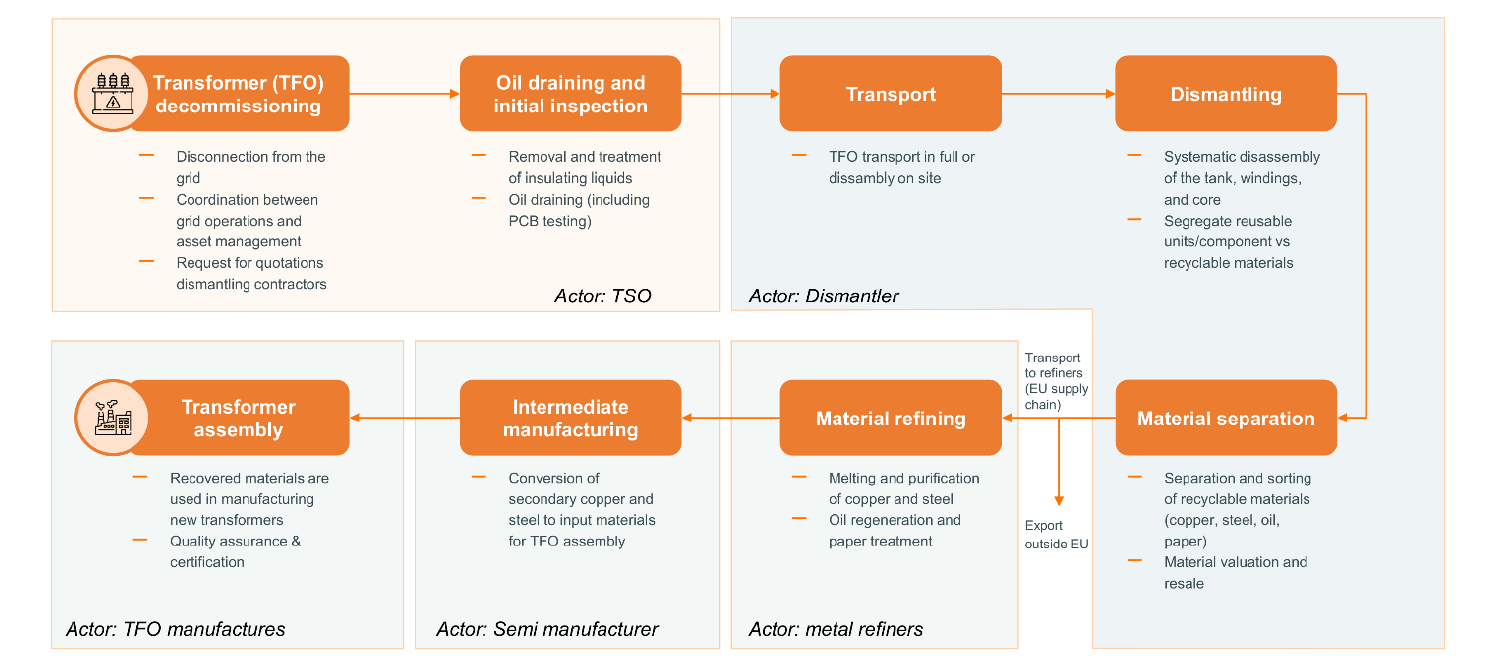
Figure 1 - Typical EoL recycling process for power transformers
2.2. Material Recovery Rates and Component-specific Routes
Based on practical experience from an industrial recycling company in the Netherlands, data from approximately 15,000 tonnes of recycled power transformer material, during a period of approximately three years, typical material recovery rates can be summarised as follows:
- Insulating oil: Approximately 96% is recycled. When the oil is reprocessed to transformer-oil grade, it can be considered circular. If it is used as fuel, it is classified as energy recovery and represents a significantly downgraded recycling route.
- Copper: Approximately 97–99% is recycled.
- Iron: Approximately 98% is recycled and around 2% is directed to incineration routes.
- Core steel: Approximately 80% is recycled, while around 20% follows scrap recycling routes similar to those of iron.
- Insulation materials (wood, paper, pressboard, cardboard, enamelled wire, epoxy): 100% are typically incinerated and used as secondary fuel.
The reported recovery rates only reflect this specific industrial practice and may vary depending on transformer design, recycling techniques and regional regulatory conditions. They refer to material recycling and do not necessarily imply reuse in new transformer applications.
Component-specific recycling routines are summarised as follows:
- Bushings: Bushings are dismantled into their different material fractions. Many older transformers still have bushings made of porcelain. This porcelain is reused as crushed aggregate, for example in road construction. Bushings with a plastic or silicone insulator are increasingly common. These plastic components are sent for incineration. Oil-impregnated paper or resin-impregnated paper is also sent for incineration. The remaining materials present in bushings, such as iron and copper, follow the recycling routes as described above.
- On-load tap changer (OLTC): OLTCs consist of a hard paper tube, which can also be made of cast resin. These materials are sent for incineration. Copper contacts, sometimes silver-plated, are sent to a smelter and follow the recycling routes as described earlier.
- Fans: Fans are usually made of aluminium or iron. These materials follow the conventional recycling route and are sent to a smelter. If plastic fan blades are present, these are sent for incineration. The drive system is provided by an electric motor. This electric motor consists of approximately 12% copper, 5% insulation material, and the remainder is iron or aluminium.
2.3. Recycling Process Changes and Expectations
Over the last decades, transformer recycling has evolved from predominantly scrap-oriented processing to more controlled and traceable material management. Key developments include more selective dismantling, stricter requirements for insulating oil treatment, tighter regulation of hazardous substances, and higher customer requirements regarding circularity metrics and reporting. In practice, physical material flows are increasingly accompanied by “data flows” documenting material composition, routing, and regulatory compliance.
In the coming decades, further tightening of waste shipment and export-related transport regulations are expected. This will require more robust substantiation of material classification, routing, and traceability, particularly for hazardous substances. Requirements for site layout and operational facilities, such as liquid-tight floors, shelter facilities and environmental protection measures, are also likely to become stricter. Rather than a dramatic increase in recycling rates, future developments are expected to focus on improved verification, documentation, and auditable evidence of recovery rates and downstream treatment routes.
In parallel with regulatory trends, a stricter split between material qualities, such as separating high-grade from low-grade copper, could be more widely required, further formalising quality segregation practices. Examples include scrap material export could be more complex following the European Union (EU) Regulation on Shipments of Waste [7] and the forthcoming Circular Economy Act, for which the European Commission has launched a public consultation and call for evidence [8]. In addition, geopolitical and macroeconomic factors can affect access to critical materials such as copper and aluminium, increasing the relevance of circular strategies, lifetime extension, and demand-side measures to reduce material intensity.
Finally, while recycling of valuable scrap materials is necessary, it is unlikely to fully meet the rising demand driven by electrification. Competing demand from other industries can further increase pressure on supply chains. Geopolitical instability and policy shifts in resource-rich regions may rapidly alter market conditions. These risks are difficult to mitigate at the TSO level, reinforcing the need for resilient supply chains supported by robust circular-economy frameworks and transparent material traceability.
2.4. Challenges
Challenges from the TSO perspective:
- Limited and inconsistent availability of high-quality secondary metals that meet strict TSO technical requirements, compounded by long asset lifetimes that slow material return flows.
- Growing risks to raw material supply chains, as dependence on imports exposes TSOs to geopolitical volatility and price shocks.
- A fragmented European recycling landscape with insufficient incentives, harmonised standards, and industrial coordination to support robust closed-loop recycling chains.
- The need for design rethinking and new technologies to reduce material use, such as copper-light solutions (while always maintaining high efficiency/low losses according to European regulation EU 2019/1783[10]), extend the lifetime of existing assets, and lower demand for new materials, thereby easing pressure on critical raw material supply.
Challenges from the OEM perspective:
- Limited availability of reliable recycling data from material suppliers and limited information on downstream recycling routes at the EoL stage, complicating the preparation of environmental product declarations (EPDs) and life cycle assessments.
- Design and manufacturing constraints that limit dismantling and separation efficiency, particularly due to the use of composite materials and mixed-material components, and that require trade-offs between technical requirements, cost and circularity objectives.
- Transformer specific assumptions for EoL are not well defined. OEMs that are producing these and calculating the associated LCAs have less insight in the EoL of their products as these actions are controlled by the product owners. As a modelling example, OEM typically applies the EoL assumptions defined by TSOs during some of the earliest customer LCA requests, and these assumptions are assumed to be representative of the recycling rates for these large assets with significant quantities of valuable metals.
Challenges from the material supplier perspective:
- The need to supply critical materials such as copper and silver, while competing with unprecedented demand for data centres and artificial intelligence (AI) development.
- Surging demand for critical minerals and raw materials for the energy transition, military equipment and AI. Supply-demand imbalances and geopolitical events are expected to keep raw material prices highly volatile, creating uncertainty for investment and contractual agreements.
These challenges highlight the need for closer coordination across TSOs, OEMs, material suppliers and recyclers to align technical requirements, data transparency and circular-economy objectives.
3. General EoL LCA Methodology for Transformers
3.1. General Methodological Framework
The EoL stage of transformers is modelled for the major material components, including copper windings, electrical steel components and insulating oil. These materials are recovered at high recovery rates, reprocessed to equivalent quality, and reintegrated into transformer production or other electrical equipment with equivalent functional performance. The EoL treatment of transformers can therefore be regarded as closed‑loop recycling. Closed-loop recycling refers to secondary materials being reintegrated into the same product system with equivalent functional quality, while open-loop recycling supplies other product systems and may involve downcycling.
To ensure alignment with policy frameworks underpinning future EU regulatory requirements, the EoL assessment follows the Product Environmental Footprint (PEF) methodology [9]. PEF emphasises the allocation of recycling‑related burdens and benefits between the TSO and the recycler, as well as changes in material quality before and after recycling. Accordingly, the Circular Footprint Formula, incorporating substitution from the avoided‑burden approach and allocation principles from the cut‑off approach, is applied using the A‑factor as a market‑based allocation parameter.
From an environmental impact perspective, the assessment quantifies not only greenhouse gas emissions related to climate change, but also emissions of hazardous substances specific to transformer EoL treatment, notably PCBs and heavy metals. These are evaluated using relevant environmental impact categories, including climate change, human toxicity, ecotoxicity and resource depletion, enabling a comprehensive evaluation of transformer EoL management beyond CFP alone.
3.2. OEM Modelling Practice
The following discussion reflects modelling practices observed for a representative OEM and is presented to illustrate practical methodological considerations rather than to establish universally applicable industry practice.
In practice, some OEMs adopt a pragmatic approach to modelling transformer EoL by starting with the bill of materials and then applying the standardised EoL assumptions derived from TSO-defined requirements to quantify the EoL phase. For the OEM considered here, the modelling approach originated from early customer-driven LCA requests and was subsequently applied beyond domestic tenders to selected international bids. In this context, standardised EoL datasets have increasingly functioned as reference frameworks that improve cross‑LCA comparability, albeit on the implicit assumption that recycling capabilities across different regions are broadly comparable despite variations in legislation.
In practice, challenging such assumptions can be difficult for OEMs. Once delivered, transformers fall under the responsibility of TSOs, while EoL typically occurs several decades later and lies outside OEM accountability. In addition, the EoL contribution to total lifecycle impacts is generally small compared with the use phase. In recent years, LCA practice in power transformers has increasingly shifted from CO₂‑centric assessments with generic recycling rates toward more explicit and technically grounded EoL modelling. This shift reflects growing recognition of the high recyclability of transformers as well as increasing customer expectations in tenders.
Based on this example and broader sector discussions, several priorities can improve modelling accuracy and decision relevance:
- Enhanced traceability of actual EoL pathways to move beyond generic assumptions.
- Stronger methodological alignment and material‑flow control as LCA becomes strategically relevant for procurement and asset management.
- Higher‑quality data that includes materials below conventional 1% mass-based cut-off thresholds and emerging substances of concern (e.g., PFAS), while broadening beyond CO₂‑equivalent to more impact categories.
- Increased supply‑chain transparency, supported by sector efforts to obtain realistic recycling and recovery data.
- Gradual transition from standardised databases toward product‑specific and context‑dependent datasets and methods.
For the OEM case considered, key obstacles include the imperfect fit of assumptions to transformers and the inadequate treatment of lifetime extension in LCA. From a methodological perspective, updating generic EoL parameters with dismantler data on actual recovery rates is a practical first step. A key remaining methodological challenge relates to the treatment of lifetime extension. Because longer service life currently inflates cumulative impacts, lifetime extension may appear environmentally unfavourable despite clear sustainability benefits. Reporting impacts per year of operation or per unit of transformed power could provide a more balanced representation of extended service life.
4. EoL LCA Case Study
The LCA methodology presented in the last section provides a generic approach for assessing the transformer EoL stage. The following case study does not aim to fully implement this framework. Instead, this section uses a representative example to illustrate how EoL treatment choices can significantly influence environmental impacts. The LCA example compares the environmental impacts of oil treatment and oil replacement as mitigation measures for PCB-contaminated mineral oil in power transformers. The functional unit is defined as 50 t of oil, with transportation assumed to be by truck. The PEF method was applied using data derived from the ecoinvent database as provided in the underlying LCA study, for which database version and system model details were outside the scope of this work.
The dehalogenation process consists of three sections:
- Section 1 – chemical decomposition of polychlorinated biphenyls
- Section 2 – adsorptive purification of decontaminated oil
- Section 3 – drying and filtration
Furthermore, Best Available Techniques (BAT) Reference Documents (BREFs) recommend the dehalogenation process for PCB-contaminated mineral oils. The amount of contaminated oil depends on the power rating and voltage level of the transformer. The process waste is PCB-free and consists of chlorinated compounds and alkaline components in the form of sludge, which is sent for incineration, thereby significantly reducing the amount of generated waste.
Incineration involves oxidative thermal decomposition of PCB molecules at very high temperatures, above 1100 °C, in the presence of oxygen. A drawback of incinerating PCB-contaminated oil is that if the process temperature falls below 1100 °C, incomplete combustion may occur, leading to the formation of dioxins and furans, compounds that are even more toxic than the PCBs.
A comparison of dehalogenation and incineration process contributions to impact categories is presented in Table I [11].
| Impact Category/Indicator | Dehalogenation | Incineration |
| CLIMATE CHANGE, t CO2-eq | 21.1 | 215.7 |
| OZONE DEPLETION, kg CFC-11-eq | 4.32 · 10-4 | 0.05 |
| ACIDIFICATION, mol H+ | 48 | 705 |
| FRESHWATER EUTROPHICATION, kg PO4-eq | 0.45 | 3 |
| MARINE EUTROPHICATION, kg N-eq | 9 | 120 |
| TERRESTRIAL EUTROPHICATION, mol N eq | 96 | 1352 |
| PHOTOCHEMICAL OZONE FORMATION, kg NMVO-eq | 34 | 1541 |
| DEPLETION OF MINERAL AND METAL RESOURCES, kg Sb-eq | 0.098 | 2 |
| FOSSIL FUELS DEPLETION, GJ | 240 | 2888 |
| HUMAN TOXICITY- CARCINOGENIC, CTUh | 4.88 · 10-6 | 1.08 · 10-4 |
| ECOTOXICITY, kCTUe | 963.1 | 1984.8 |
| HUMAN TOXICITY- NON-CARCINOGENIC, CTUh | 1.69 · 10-4 | 0.002 |
| PARTICULATE MATTER EMISSIONS, kg PM-10-eq | 4.98 · 10-4 | 0.007 |
| IONIZING RADIATION, MBq U-235eq | 0.278 | 15 |
The results of the dehalogenation process represent cumulative impacts of Sections 1, 2 and 3. Based on the results of Table I, dehalogenation has significantly lower impacts in each impact category. The carbon footprint of the incineration process is approximately ten times higher than that of the dehalogenation process. For transformers containing 50 t of PCB-contaminated oil, greenhouse gas emissions reach 215.7 t CO₂-eq, representing a substantial environmental burden, particularly in the context of rising carbon prices.
5. Conclusions
This paper assessed the EoL stage of power transformers from both an industrial recycling perspective and a LCA methodological perspective. Although operational losses remain the dominant contributor to life cycle environmental impacts, EoL strategies can provide measurable benefits through high material recovery rates and the substitution of primary raw materials. In the context of increasing material demand and potential supply constraints, EoL management represents an opportunity to mitigate supply chain risks. Realising this potential requires improved coordination and transparency among stakeholders to enable efficient material recovery and support necessary industrial developments. Transformer EoL management is evolving in response to regulatory frameworks, increasing traceability requirements, and growing resource-security considerations for OEMs and TSOs. Future progress would benefit from more transparent and harmonised reporting of dismantling outcomes and downstream recycling routes.
Acknowledgement
The authors acknowledge the contribution of industrial data related to transformer recycling processes by Interbaro Recycling B.V.
References
- C. Li, W. Zhou, and H. Wu, "Recycling of power grid waste: Carbon footprint of cables and transformers," Journal of Physics: Conference Series, vol. 2956, no. 1, IOP Publishing, 2025.
- W. Li, Y. Bian, Y. Zhang, E. Zhou, and L. Xie, "Research on the carbon footprint accounting method of transformer’s whole life cycle under the background of double carbon," Energies, vol. 18, no. 3, Art. no. 499, 2025.
- Y. Wang, H. Zhang, E. Zhou, L. Xie, and J. Li, "Carbon footprint analysis of distribution network transformers based on life cycle assessment," Energies, vol. 18, no. 3, Art. no. 600, 2025.
- X. Bai, P. Li, W. Zhou, C. Li, H. Cui, and N. Ding, "Evaluating material recycling and carbon emission reduction potential of typical grid retirement equipment," Journal of Physics: Conference Series, vol. 3129, no. 1, IOP Publishing, 2025.
- G. Z. Makashova, J. Bruijnen, and S. Wesemann, "Life cycle assessment of dry-type distribution transformers," Transformers Magazine, vol. 12, no. 2, pp. 90–100, 2025.
- IEC 60296:2020, Fluids for electrotechnical applications – Mineral insulating oils for electrical equipment, International Electrotechnical Commission, Geneva, Switzerland, 2020.
- Regulation (EU) 2024/1157 of the European Parliament and of the Council on shipments of waste, European Union, 2024.
- European Commission, "Commission launches consultation and call for evidence for upcoming Circular Economy Act," Directorate-General for Environment, 2025. [Online].
- European Commission, PEFCR Guidance – Guidance for the development of Product Environmental Footprint Category Rules (PEFCRs), Version 6.3, 2017.
- Commission regulation (EU) 2019/1783 of October 2019 amending regulation (EU) No548/2014.
- Milica Djukic, "Application of the Circular Economy Concept and LCA Analysis of Dehalogenation Technology for PCB-Contaminated Transformers," Master’s thesis, University of Belgrade, Serbia, 2023.