Integration of Large Power Electronics-Interfaced Loads in Power Systems: Challenges and Opportunities - Part II: Connection Process, Operations and Planning Considerations
CIGRE Large Load Joint Task Force C4, C2 & C1
J. MATEVOSYAN - Joint Task Force Lead, ESIG
B. BADRZADEH (Bespoke Energy), E. MEIER (ERCOT), T. KËRÇI (EirGrid), A. ILLICETO (Terna), J. DEANE (SE), Y. SUN (Shell), L. ROBINSON (AEMO), A. BROCHARD (TE-H2)

Summary
This white paper is Part II of a two-part publication on the grid impacts and integration challenges associated with the rapid growth of large power-electronic-interfaced loads. Part I, published in June 2026, established the technical foundation by introducing definitions and categories of large loads, highlighting key differences between emerging large loads and traditional industrial loads, and discussing coordination gaps among stakeholders involved in their integration. It then examined major grid impacts, including implications for stability, resource adequacy, and system flexibility, and discussed the need for suitable modeling approaches and grid-facing performance specifications to support reliable integration. Part II addresses issues related to large-load connection processes, as well as operations and planning considerations associated with their increasing deployment. It concludes with a summary of risks / opportunities where additional work, potentially carried out by future CIGRE Working Groups, is required.
1. Large load connection process
Historically, demand has generally been connected through standard network planning procedures to accommodate incremental growth, with detailed connection studies reserved for a small number of very large or disturbance-sensitive industrial loads (such as arc furnaces, aluminum smelters, and large mining operations). However, as power-electronic-interfaced loads (PEILs) with fast control response scales up to several hundred MW and, in some cases even GW, they can influence voltage profiles, harmonics, and stability in ways that require generator-style assessment prior to connection. This increased scale and dynamic behavior introduces new technical and governance challenges for system operators and network owners, developers, and OEMs.
1.1. Challenges faced by system operators and network owners
Connecting PEILs to the transmission system poses challenges to system operators and network owners as many of them lack well-established requirements for technical performance, data and model intake, connection studies and commissioning process for this type of load. System operators and network owners must study these facilities across both the steady-state and dynamic domains to ensure system reliability. To manage this, they need a process that defines data and modeling requirements, connection process milestones for model submission and inclusion in various studies.
System operators and network owners are also strained by developers submitting multiple exploratory applications for each new facility at different locations. This consumes valuable engineering resources to study each application even if some are speculative and will never be built. System operators also need to establish project readiness criteria for inclusion of large PEILs projects in planning assessments, to avoid inclusion of projects that are not likely to reach commercial operation.
As the number of PEIL connection requests grow along with facility sizes, PEILs impact other nearby PEILs as well as other connection requests by traditional loads, generators and storage plants. This requires that they be studied concurrently in clusters so the grid can be planned to serve all projects in a specific region and time-window efficiently. Additionally, as projects modify or withdraw their application, the results of previous studies can be invalidated for nearby PEILs, causing time-consuming rework. Each new result can then trigger another restudy resulting in potentially endless loops as previously seen with generation interconnection cluster studies.
Data needs
A key challenge during the early stages of a large PEIL project is that the detailed technical information required for connection studies may not yet be available, as major equipment may still be under procurement or design. In such cases, system operators and network owners may need to rely on provisional assumptions to assess potential system impacts, particularly during initial screening studies and scenario development.
To support these assessments, PEIL developers should provide preliminary information, including expected capacity, development timelines, and project maturity, to inform transmission and generation planning as well as network reinforcement studies. Additional information on project location, expected facility build-out rates (if built in phases), demand profiles, utilization scenarios, power supply reliability requirements and development likelihood can also help improve load forecasting and planning accuracy.
System operators and network owners would also greatly benefit from deeper visibility into potential duplicate or exploratory connection applications submitted by developers. On the other hand, system operators may consider providing high-level locational guidance to help identify areas of the network that are better suited for PEIL development, thereby supporting more efficient siting decisions and facilitating the connection process. Hosting capacity analysis and dissemination is becoming a necessary standard feature for steering and then managing the extremely high number of connection requests appearing in several portions of power grids [1].
1.2. Challenges faced by developers
Developers of large PEILs face a number of challenges when seeking to connect their facilities to the grid. One of the primary difficulties is identifying locations with favorable connection opportunities in terms of cost, available generation and transmission capacity, and time to reach commercial operation. Limited transparency regarding “network headroom”, such as hosting capacity, system strength, fault level margins, and other network constraints, often drives developers to undertake multiple pre-application enquiries or submitting multiple connection applications for a single project, placing unnecessary additional burden on engineering staff.
Project development also requires balancing technical and economic trade-offs, including schedule, efficiency, and technology choices. Selecting equipment from OEMs therefore involves evaluating state-of-the-art solutions while ensuring that the selected configuration can meet both the PEIL facility needs and grid performance expectations without introducing additional technical compliance costs.
Uncertainty around technical performance specifications, data and modeling requirements can complicate project design by leaving developers without a clear design target. As a result, projects may face redesigns, schedule delays, and unexpected costs when requirements are clarified later in the development process. In some cases, system operators may ultimately require performance beyond the capabilities of the initially selected OEM configuration, necessitating additional equipment or plant design modifications.
Another challenge is that key technical information about facility capability is often preliminary during the early stages of development, as it depends on hardware selection decisions that may not yet be finalized.
Finally, the lack of standardization in connection processes, documentation, requirements and grid connection agreements across regions creates additional complexity. Differences in grid codes and connection procedures often require developers to design project-specific solutions for each jurisdiction, which can slow the deployment of large PEIL facilities and inflate development costs.
1.3. Challenges faced by OEMs
Historically, OEMs supplying equipment for large load facilities have focused primarily on achieving high internal reliability and operational continuity within those facilities. However, system operators and network owners are increasingly introducing new grid-facing performance and modeling requirements for large PEILs. In particular, detailed phasor-domain transient (PDT) and electromagnetic transient (EMT) models are now being requested for PEIL facilities and their subsystems [2]. Many OEMs have experience developing such models for generation equipment, but applying similar modeling practices to power-electronic equipment used within large load facilities and integrating these into validated facility-level models suitable for power system stability studies remains relatively new.
Another challenge is determining which components of a PEIL facility materially affect grid reliability and therefore require detailed representation in power system studies, and which components can be simplified or excluded without influencing study outcomes.
OEMs must also navigate a wide range of performance requirements across different jurisdictions. As previously discussed, these requirements often vary significantly between grid operators and, in many cases, are still evolving. Lack of clarity and uniformity makes it difficult for OEMs to anticipate the final performance requirements against which their equipment will ultimately be assessed and whether current designs will remain compliant. As a result, decisions to invest in product modifications can be challenging. Depending on the final performance requirements, necessary changes may range from firmware and control adjustments to more extensive hardware redesigns, with associated increases in cost and development timelines.
Greater harmonization of performance requirements and clearer transitional arrangements would help reduce uncertainty, minimize rework, and allow OEMs to plan product development and investment more effectively.
1.4. Regulatory treatment of co-located generation or storage
Traditionally, large loads have been supplied entirely by energy drawn from the grid. However, there is growing interest in co-locating generation and energy storage with large PEIL facilities to improve security of supply, meet emerging performance requirements, and accelerate project energization timelines.
In most grid codes, front-of-meter facilities are classified into three main categories: load, generation, and energy storage. Before submitting a connection application, the connecting party is typically required to identify the facility under one of these categories, as this determines the applicable technical requirements and study processes.
With the growing scale of PEIL facilities, co-locating with generation or energy storage is increasingly considered as a means to reduce reliance on grid capacity and mitigate connection constraints. In such cases, where a PEIL is combined with front-of-meter generation or storage, the scope of the connection and the applicable performance requirements should be clearly defined, particularly where they differ from those of a passive (load-only) connection. Connection processes and performance requirements therefore need to evolve to appropriately address co-located front-of-meter configurations.
In addition to front-of-meter arrangements, generation can also be deployed behind the meter at PEIL facilities. In these cases, on-site generation may serve as backup power or provide part of the facility’s energy supply (see Part I for more details). When modeling and evaluating such configurations, several factors should be considered:
- Type of on-site generation technology and expected deployment trends (e.g., diesel, hydrotreated vegetable oil, natural gas, hydrogen, batteries, UPS).
- Backup power strategies and operational constraints for PEIL facilities, including the interaction of different backup technologies.
- Available backup capacity and duration of autonomous operation, including the portion of facility load that can be supported during grid interruptions.
- Potential impacts on grid stability, including disturbance ride-through capability, reconnection behavior, and synchronization requirements where applicable.
2. Operation with large loads
2.1. Real-time management of operational security and stability
As discussed in Part I, large PEILs can introduce challenges for power system operation due to their distinctive electrical characteristics. These include rapid MW variations and disturbance responses that may be fast, non-linear, and technology-dependent, such as sudden demand reduction or disconnection during faults or voltage depressions. To understand and manage these behaviors, system operators must capture and represent PEIL characteristics in system models and assess their potential impacts through power system studies.
To maintain operational security, system operators perform regular security assessments and, in some regions, online dynamic security assessments. These processes use tools such as real-time contingency analysis and dynamic simulations of credible events to evaluate transient, voltage, and frequency stability and support operational decision-making. A simplified illustration of real-time security and stability management using these tools is shown in Figure 1.
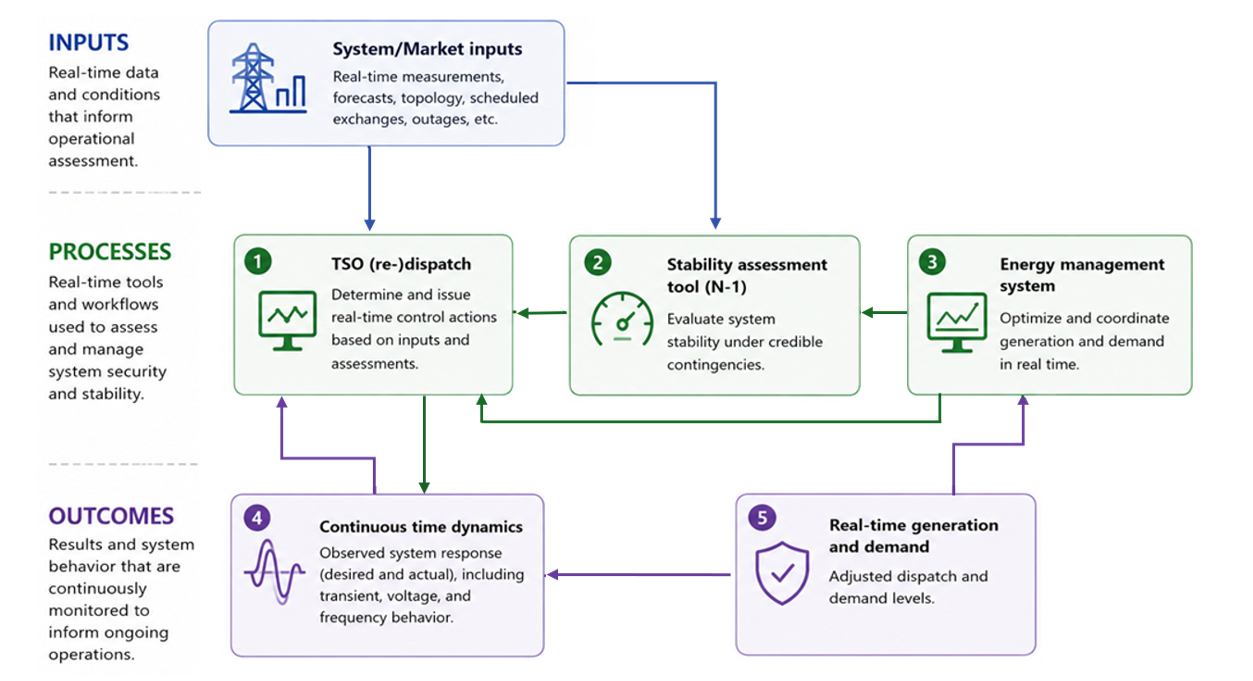
Figure 1 - Illustration of real-time management of operational security and stability in power systems
For example, if look-ahead stability assessment tools indicate that a future operating scenario could become insecure due to significant demand reduction from PEILs following a transmission fault, control room operators may take precautionary operational actions to maintain system stability. These actions may include re-dispatching generation to maintain higher levels of inertia and fast-acting reserves, restricting HVDC interconnector exports, or curtailing demand from PEIL facilities.
Such measures, however, represent short-term operational interventions rather than enduring solutions. Because these decisions rely on operator decision-support tools, it is important that accurate dynamic models of PEIL behavior are available and reflect their actual response during grid disturbances. Operational interventions can also affect other system users, including generators, batteries, and HVDC interconnectors, and may increase overall system operating costs due to higher energy and ancillary service needs. Establishing appropriate performance requirements for PEILs, as discussed in Part I, can help address stability concerns more directly and reduce the need for such operational measures.
2.2. Operational forecasting and balancing needs
At present, PEIL facilities such as data centers generally exhibit relatively predictable demand profiles at the day-ahead stage. However, as their energy consumption grows, particularly with the expansion of artificial intelligence (AI)-driven data centers that may exhibit short-duration power spikes, the need for more advanced operational forecasting becomes increasingly important to avoid potential grid stability concerns.
From a balancing perspective, the absence of HVRT and LVRT capability at some PEIL facilities, discussed in Part I, can increase the system’s reserve needs, particularly for fast frequency response needed to maintain frequency within secure operational limits. Note that some regions may not even have reserve products designed to address rapid, large overfrequency events (due to loss of large PEILs), as system operators have traditionally been more concerned with loss of generation and associated underfrequency events. In addition, higher minimum inertia levels may be required to limit the rate of change of frequency (RoCoF) following instantaneous demand reduction caused by PEIL disconnection during transmission faults or voltage depressions.
One approach to addressing this challenge is for system operators to explicitly account for potential PEIL demand reductions when determining reserve requirements. For example, the Irish transmission system operator recently proposed a methodology in which reserve requirements are dimensioned based on the expected Reference Incident (RI) [3], explicitly considering the potential system impact of large load disturbances. The RI is composed of the largest single infeed/outfeed (LSI/LSO) loss plus consequential loss (Closs) of generation and demand (e.g., distributed energy resources and PEILs), as follows:
RI+ = LSI + Closs
RI- = LSO + Closs
However, beyond increasing reserve procurement costs that are ultimately borne by consumers, this approach raises a key challenge: determining the balancing capacity needed to account for potential consequential loss of demand from PEILs (as a part of Closs). While detailed dynamic studies could, in principle, be used to estimate demand reductions following faults, the lack of validated PEIL models makes such assessments difficult. Similar challenges arise when estimating loss of generation from DERs, as detailed dynamic models remain limited and their ride-through performance is often uncertain.
2.3. Enabling flexibility in operations
Increased flexibility from PEILs will be important for integrating higher shares of large loads and renewable generation as well as meeting climate targets. However, mechanisms to effectively enable flexible demand from these facilities are still evolving. One potential pathway is to encourage the participation of PEILs in wholesale electricity markets in a manner similar to generators, i.e. a PEIL facility:
- Submits schedules and forecasts,
- Participates directly in energy, ancillary service, and/or capacity markets,
- Bears performance obligations applicable to each of these markets,
- Submits price-sensitive demand bids (bid-to-buy curves) into the energy market.
- Responds to dispatch instructions,
For such participation to be effective, however, the flexibility offered by PEILs must be reliable and available when required, implying a need not only to demonstrate capability but also to monitor availability and performance.
If voluntary participation in wholesale markets proves insufficient, mandatory participation for facilities above a certain size threshold could be considered. Similar requirements already apply to generators in many markets, for example, units above a specified export capacity (e.g., 10 MW) are typically required to participate in wholesale energy markets.
It is also important to recognize that PEIL flexibility is often provided primarily through downward adjustments in demand. However, upward flexibility, in the form of dispatchable demand, can also provide system value, for example by increasing consumption during periods of surplus renewable generation and thereby reducing curtailment.
Finally, enabling flexibility from PEILs connected at the distribution level will also be important, given their growing number and scale. Effective coordination between transmission and distribution system operators will therefore be essential.
2.4. Needs for monitoring and situational awareness
For general information, monitoring and control purposes, SCADA data, typically sampled every few seconds (e.g., 3-5 s) is suitable. However, to be able to accurately analyze transient events such as transmission faults and the behavior of large PEILs during these events, it is important that high-resolution data is available to system operators and PEIL owners. Equipment such as PMUs installed at or near PEIL sites with reporting intervals in the order of tens of milliseconds (e.g., 20 ms) can support time-synchronized event visibility. Disturbance or fault recorders can provide much higher waveform sampling rates (often kHz, sub-millisecond) for detailed analysis. Such high-resolution data is also critical for PEIL facility model validation purposes.
2.5. Emergency Load Control for Security of Supply
In emergency situations where generation capacity is insufficient, load shedding may be required to maintain system stability. However, in regard to large PEIL facilities, grid operators and network owners may currently lack a consistent and scalable communication framework to issue operator instructions or enable automated demand reductions. Emergency management plans should therefore explicitly consider PEILs and establish clear processes for managing their demand during system emergencies.
Demand reduction from PEILs should be treated as a last-resort mitigation measure under defined emergency conditions. Implementing such measures would require appropriate contractual arrangements between PEIL owners and system operators. However, several aspects remain to be clarified, including the triggering conditions for activation, the degree of obligation versus voluntary participation, verification and settlement mechanisms, and whether and how such flexibility should be compensated.
3. Grid planning with large loads
3.1. New planning challenges brought by large PEILs
PEILs have a substantial impact on power systems, driving electricity demand and the associated need for generation and network infrastructure investments. As a result, they are emerging as a key element of the evolving energy landscape, influencing load characteristics, system operations, grid stability, and renewable energy integration. Their importance is likely to grow further as advances in digital technologies and sustainability initiatives continue to transform both the electricity and digital sectors.
Grid planning was traditionally based on scenarios encompassing demand forecast and generation expansion plans, targeting to cover demand with adequate margin in the most cost-effective way. Recently further inputs for planning have been added, namely demand response capabilities, battery storage, sector coupling considerations (EV charging infrastructure, electrolyzers, long duration storage through conversion to other energy forms, thermal storage and combined heating/cooling systems).
Planning for large PEILs is an additional disrupting change in traditional planning scenario building and raises the following issues, distinct but intertwined:
- Misalignment between the pace of demand growth and multi-year grid development processes, compounded by uncertainty arising from “capacity hoarding” by large loads [4].
- Connection process needing a revision of scope to address requests clustered in time and space through batch studies rather than one-by-one, as discussed in Section 1.
- Connection process needing a revision in modality to introduce queue management criteria based on project readiness, as first come-first-serve approach to grant fair treatment to all applicants is no longer suitable for optimal transmission and generation expansion planning.
- Planning criteria must become more holistic and encompass many alternatives to grid physical expansion, such as demand response, flexible connection agreements, various storage options to shift energy in time rather than shifting it in space.
- PEILs needing fast connection may be required to partially (or even totally) rely on their own new generation to maintain adequacy of both generation and transmission capacity.
- A Flexible Connection Agreement can be envisaged, where a base amount of withdrawable capacity is guaranteed while another portion is available under certain conditions or restrictions.
3.2. Load forecasting for the grid and resource planning
PEIL size and characteristics distinguish them from any other type of electrical load. Their load profiles and specifications, related to the services provided, are highly relevant for grid operators. Moreover, most large PEILs take several years to reach their full requested load level, resulting in a gradual increase in generation and network capacity needs rather than an immediate step change. Understanding these large load characteristics is critical for effective system planning:
- Load profile: analysis of load profiles during all relevant time horizons, i.e. hours of the day, days of the week (workdays vs weekends), months and seasons. Seasonality and geographic differences of load profile for different cooling technologies and climate patterns; understanding of load composition (e.g., cooling, computing, underlying industrial process etc.) and corresponding load variations and specificities depending on the end-uses of PEIL.
- Load trajectory: analysis on average time needed by PEIL, differentiated by the services offered, to reach contracted capacity and maximum capacity to be expected to plan stepwise connection solutions.
- Load flexibility: understanding flexible connection agreements that can be adopted, with agreed and mutually beneficial rules to provide a firm capacity and on top a non-firm capacity, e.g. depending on time of day or contingencies.
- Energy efficiency gains: analysis of the evolution of technology used at PEILs, impacting their power needs, which have an impact on load and connection requests and, therefore, on grid planning.
- Incentives: an important aspect to be analyzed is how to incentivize connection of PEIL in areas where the system is less constrained.
If the above factors are not carefully analyzed and considered in planning, there is a significant risk of suboptimal generation and grid expansions, longer than necessary connection times, and higher costs for all stakeholders.
3.3. Resource adequacy considerations
The rapid growth of large loads raises important considerations for resource adequacy planning. In particular, system planners must assess whether sufficient new generation capacity will be available to meet the additional demand, especially in cases where the load cannot be fully supplied by new renewable resources. Because facilities such as data centers require continuous and highly reliable power to operate servers, cooling systems, and other critical infrastructure, their demand profiles can place sustained pressure on generation adequacy.
At the same time, large load developers are increasingly pursuing sustainability objectives through renewable power purchase agreements and other low-carbon energy procurement strategies. Many facilities seek to match their electricity consumption with renewable generation, typically from wind, solar, or hydro resources. Some projects also explore co-located or on-site renewable generation to further reduce their emissions impacts and improve supply resilience. These developments have implications for resource adequacy planning, as planners must consider the timing, availability, and correlation of new renewable generation with the demand of large load facilities, as well as the potential need for complementary firming capacity or storage to maintain reliable system operation.
3.4. Flexibility considerations in planning
Understanding the flexibility potential of large PEILs is important for both generation expansion and transmission planning. A key starting point, again, is the characterization of load profiles, including daily, weekly, and seasonal variations and the operational drivers behind them. This analysis should also evaluate the extent to which demand can be modulated through mechanisms such as load shifting, peak shaving, or temporary demand reduction to support overall system flexibility needs.
Both temporal and spatial flexibility should be considered. In some cases, demand may be shifted over time or redistributed geographically, for example, among multiple sites operated by the same company. In AI data centers, certain computing tasks such as model training may potentially be scheduled to align with periods of energy surplus or reduced system stress, thereby helping mitigate peak demand or congestion on the grid. Understanding the criteria and operational constraints governing such energy management strategies is therefore important, including whether these adjustments occur only during contingencies (e.g., outages or network constraints), follow predefined operating schedules, or can respond dynamically to system conditions.
Demand flexibility can arise through both implicit and explicit demand response mechanisms. Implicit demand response refers to adjustments in consumption driven by price signals, such as time-of-use tariffs or wholesale price exposure, which can influence load profiles and reduce peak demand. Explicit demand response, by contrast, involves active participation in flexibility or ancillary service markets, where demand reductions or adjustments are contracted and subject to defined performance obligations.
When assessing the role of PEIL flexibility in system planning, it is important to realistically evaluate the technical capabilities, economic incentives, and potential barriers for participation in both forms of demand response. Interactions between implicit and explicit mechanisms should also be considered, as facilities responding to retail tariff signals may have limited ability to simultaneously provide contracted flexibility services.
In some jurisdictions, large loads such as data centers are already providing system services, for example, certain facilities in Ireland participate in fast frequency response markets. However, questions remain regarding the conditions under which such participation should be allowed, particularly when facilities may not yet comply with emerging performance requirements such as fault ride-through (FRT). More broadly, the ability of PEILs to contribute flexibility to the power system will depend on the development of appropriate regulatory frameworks, market rules, and technical requirements that enable their participation while maintaining system security.
3.5. Grid planning with PEILs: specific topics to be addressed
The growing scale, number, and concentration of PEIL require both transmission and distribution planning processes to consider several key aspects:
- Facility categories and business models – The type of facility, ownership structure, and services provided (e.g., data processing, hydrogen production, industrial processes) influence operational characteristics and the ability of the facility to comply with grid performance specifications or respond to network constraints.
- Siting considerations – The location of PEIL connection requests is often driven by non-electrical factors such as proximity to end-users (e.g., latency requirements for data centers), access to industrial demand (e.g., hydrogen consumption), water availability, or land use constraints. At the same time, system operators may seek to influence siting decisions through planning signals or connection policies that encourage development in areas with greater network capacity or lower congestion.
- Facility electrical architecture and modeling requirements – For effective grid planning and stability assessment detailed and validated models that represent the aggregated dynamic behavior of PEIL facilities are needed.
- Connection performance capabilities – Planning studies must consider whether PEIL facilities can meet relevant grid performance expectations, such as FRT capability, reactive power support, and frequency response.
- System stability considerations – Large PEIL installations may interact with the grid in ways that affect system stability, particularly in networks with low system strength. Potential issues include control interactions with other converters, oscillatory behavior, resonance phenomena, harmonic emissions, and impacts on active and reactive power balance.
- Resilience to large-scale disturbances – The resilience of PEIL facilities during local, regional, or national blackouts should be considered, including potential operational impacts, service disruptions, and mitigation strategies.
Because PEIL connection requests are often large in size and geographically concentrated, they should be assessed in a holistic manner during planning studies. Considering clusters of projects across appropriate spatial and temporal horizons can help identify coordinated connection solutions that meet individual project needs while maintaining efficient and secure system development. Lessons can be learned and best practices adopted from integration of renewable generation resources.
3.6. Need for coordination between operational and planning considerations of PEILs
To enhance coordination and knowledge sharing between the planning and operations teams within system operator organizations, it is important that both teams establish a structured collaboration mechanism. This collaboration can take the format of a periodic coordination forum and serve as an opportunity to discuss PEIL topics such as data and modeling needs, performance requirements, expected shares of PEILs including those forecasted to be connected in the distribution networks, readiness criteria to be used, expected expansion of flexible PEILs sites and how flexibility is considered in planning and operations, etc.. Such coordination is considered important as it helps both teams avoid working in silos while trying to plan and operate the same power system in a safe and secure manner.
4. Summary of key findings and future work
The two-part CIGRE Large Load Joint Task Force white paper examined the technical characteristics of large PEILs, their impacts on power system planning and operation, and the challenges associated with their connection and integration. Drawing on the findings presented in Part I and Part II of this white paper, Table 1 provides a consolidated summary of the key risks, opportunities, and areas requiring further academic and industry attention. It reflects the collective conclusions of the Joint Task Force members and highlights topics where additional work, potentially through future CIGRE working groups, may help support the reliable and efficient integration of large PEILs into power systems.
| Risk / opportunity | Additional work required |
| Ride-through performance and consequential impacts of increasing PEIL contingency sizes (including increased reserve requirements, overfrequency/overvoltage risks, and cascading events) |
|
| Lack of validated EMT and PDT models for PEIL facilities |
|
| Power quality, resonance, and control interaction risks associated with PEILs |
|
| Resource adequacy and reserve adequacy impacts associated with large PEIL growth |
|
| Emergency load control and load shedding involving PEILs |
|
| Oscillatory interactions involving PEILs |
|
| High PEIL ramp rates and rapid demand changes, including those driven by market participation |
|
| Large-scale PEIL connection processes, cluster studies, and queue management challenges |
|
| Planning uncertainty associated with PEIL growth trajectories, demand forecasts, and phased development |
|
| Limited understanding of the value and practical availability of PEIL flexibility |
|
| Insufficient coordination between planning and operations functions |
|
| Energy efficiency improvement |
|
| Regulatory framework |
|
- [1] For Europe, see the recently introduced Capacitypedia tool.
- [2] For example, EirGrid, has recently published specifications for both PDT and EMT models for Data Centres (Simulation and Modelling | Grid Codes and Compliance | EirGrid ). Also, ERCOT is currently working on Protocol Revision Request 144 (PGRRR144) Dynamic Model Submission and Review Requirements for Large Loads including Large Computational Loads www.ercot.com/mktrules/issues/PGRR144.
- [3] EirGrid & SONI, “Day-Ahead System Services Auction (DASSA) Volume Forecasting Methodology Consultation Paper V1.0”, October 2024. Available: consult.eirgrid.ie
- [4] This refers to cases in which PEIL facilities sign connection agreements for a certain MW capacity, which included future build-out plans, but it is unclear if these plans will materialize.
- [5] Transformer winding configuration affects how voltage disturbances and faults are transferred between the transmission system and the large load, including voltage unbalance, phase shifts, and zero-sequence current paths. Together with protection settings, it can significantly influence ride-through performance and the likelihood of unnecessary disconnection during system disturbance.